


Development of Optical Fiber Sensing Technology

Development of Optical Fiber Sensing Technology
▶What is an Optical Fiber Sensor?
An optical fiber sensor refers to a device in which the measurement section that detects physical or chemical quantities is composed of optical fiber or optical components, enabling the detection of various physical parameters such as temperature, strain, pressure, vibration, and current, as well as various chemical parameters. Owing to characteristics and performance not found in conventional electric sensors, some of which are listed below, new application fields for optical fiber sensors are being continually developed.
Features and Advantages of Optical Fiber Sensors
① Small Diameter and Lightweight
② Flexibility
③ High strength, durability, and corrosion resistance
④ Passive measurement unit
⑤ Voltage resistance and electromagnetic induction resistance
⑥ Intrinsic safety and explosion-proof properties
⑦ Remote measurement
⑧ Distributed and quasi-distributed measurement
Photonic Sensing Consortium for Safety and Security
From the “Introduction to Optical Fiber Sensors “ (in Japanese)
▶Introduction of DAS-VSP Technology
Our company is focused on the future opened up by such optical fiber sensing technologies, and we are engaged in applied research and technology development, including the development of highly economical monitoring systems and new exploration methods. In 2018, as part of the geothermal exploration technology development project of the Japan Oil, Gas and Metals National Corporation (JOGMEC), we conducted Japan’s first implementation of DAS-VSP at a domestic geothermal site. By utilizing distributed acoustic sensing (DAS) as a downhole receiver, we have demonstrated the feasibility of highly efficient VSP surveys using densely spaced receiving points in well environments exceeding 200°C—conditions that are challenging for conventional observation equipment—and the ability to accurately and comprehensively monitor spatiotemporal changes in vibration events occurring in the vicinity of the wellbore.
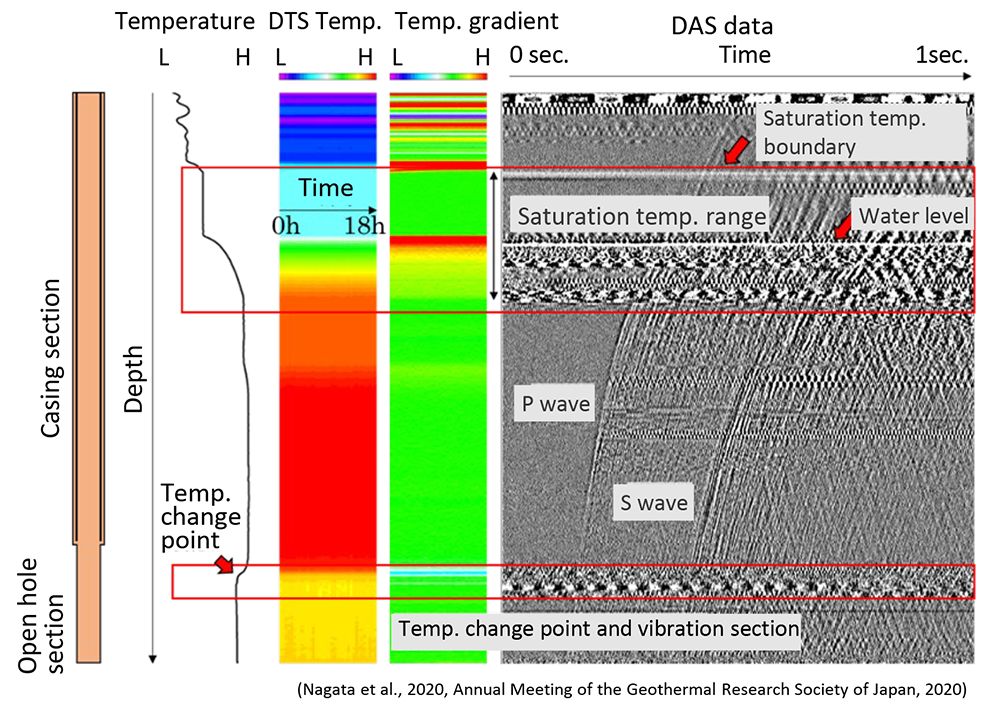
(Nagata et al., 2020, Annual Meeting of the Geothermal Research Society of Japan, 2020)
▶Optical Fiber Multi-Sensing
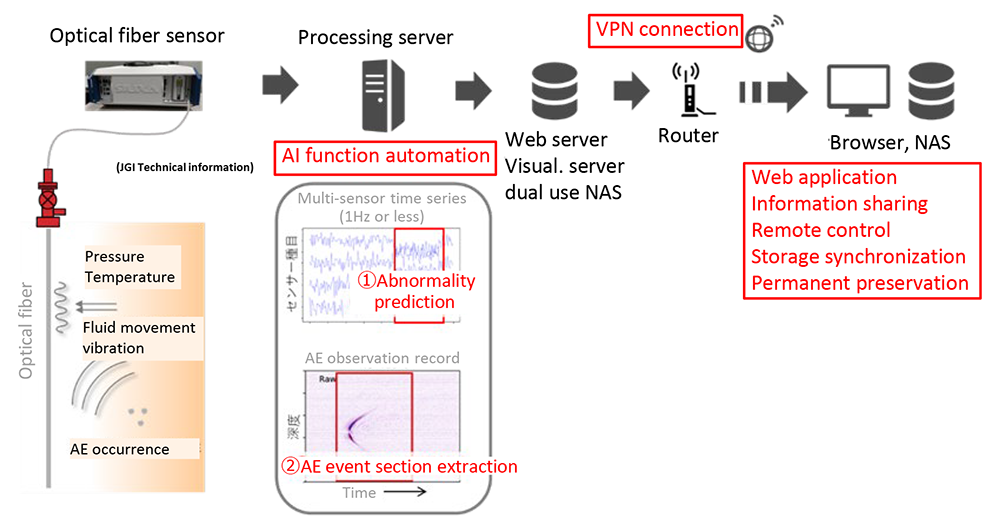
From fiscal year 2021 to 2023, we participated in the research and development project of the New Energy and Industrial Technology Development Organization (NEDO) titled ‘R&D for Innovative Technologies Applied to Geothermal Exploration and Exploitation,’ specifically in the development of ‘Long-term Reservoir Monitoring Technology Using Optical Fiber Multi-sensing and AI.’ We engaged in the development of a large-scale data remote monitoring system utilizing AI-IoT technologies. We are continuously advancing the development of a system aimed at automatically selecting seismic events—such as acoustic emissions from rock fracturing—using AI from vast amounts of DAS records collected at remote mountain well, and delivering these to end users within 30 minutes via satellite communication.